
Before You Replace It: 10 Questions That Could Save You Money
When something breaks or stops working well, replacing it can feel like the obvious next step. But before you start shopping, a few questions can help you decide whether repair, maintenance or simply keeping what you have would be the better financial choice.
TDS Money-Saving Strategist: Andrea Norris-McKnight | posted September 2026
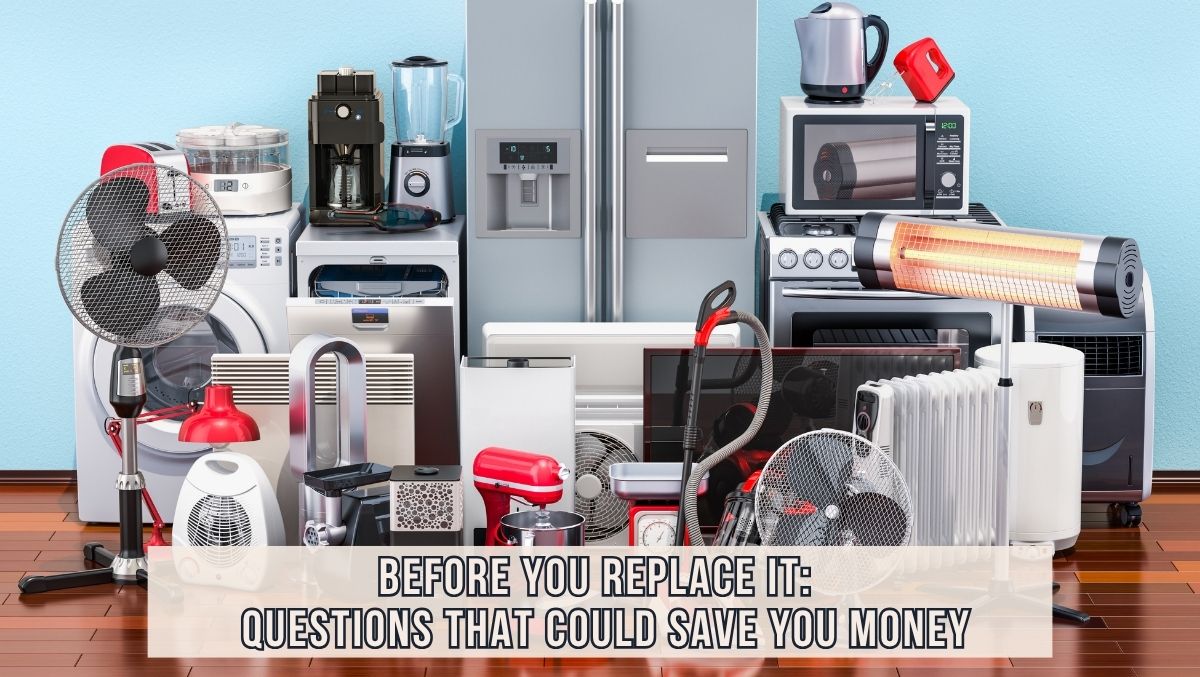
Something stops working. Or maybe it still works, but not quite as well as it used to.
Our first reaction is often to start shopping for a replacement.
Sometimes that’s exactly what we should do. Products wear out, repairs aren’t always economical and newer equipment can occasionally provide meaningful benefits.
But replacement shouldn’t necessarily be the automatic next step.
A washing machine that won’t drain may need a relatively inexpensive repair rather than a new machine. A slow laptop may need some cleanup rather than replacement. A wobbly chair may need a tightened screw.
And sometimes nothing is actually wrong with the item. We’ve simply decided it’s old.
Before spending money on a replacement, ask these 10 questions.
1. Is It Actually Broken?
This sounds obvious, but there’s a difference between ‘It doesn’t work’ and ‘It doesn’t work as well as it once did.’
There’s also a difference between ‘It no longer meets my needs’ and ‘There’s a newer version I’d rather have.’
- An appliance may be noisier than it once was but still function properly.
- A sofa may look dated but remain comfortable and structurally sound.
- A phone may lack the newest features but still handle everything you need it to do.
Before declaring something ready for replacement, identify the actual problem.
Ask: What can’t this item do that I need it to do?
If you can’t come up with much of an answer, you may not have a replacement problem yet.
2. Could Basic Maintenance Solve the Problem?
Sometimes declining performance isn’t a sign that an item has reached the end of its useful life.
It may be asking for maintenance:
- A vacuum with poor suction might have a clogged filter or hose.
- A dryer taking too long may need its lint path and vent checked.
- A refrigerator door that doesn’t seal properly may have dirty or damaged gaskets.
- A lawn mower may need routine maintenance.
- A sluggish computer may be short on storage space or running unnecessary programs.
Check the owner’s manual and manufacturer’s troubleshooting information before assuming the worst.
A little maintenance may restore enough performance to postpone replacement for months or even years.
And regular maintenance can sometimes help prevent the problem in the first place.
3. Is There a Simple Repair?
Not every repair requires a service call:
- A missing knob, worn seal, broken handle or other small component may be replaceable.
- Sometimes you can tighten or reinforce furniture.
- Clothing may need a zipper, button or seam repaired.
- A lamp may need a new socket or switch (but only attempt electrical repairs if you can do so safely).
Search for the model number and the specific problem. Check the manufacturer’s parts information and repair instructions.
You may discover that the “broken” item needs a $15 part rather than a $300 replacement.
But don’t attempt repairs beyond your skills, particularly when electricity, gas, plumbing, structural integrity or other safety concerns are involved.
Saving money isn’t worth creating a bigger problem.
Want MORE TIPS for Stretching Your Budget?
Get the free eBook with 226 simple money-saving tips — plus the Dollar Stretcher newsletter with practical, real-life ways to make a tight budget go further.
We value your privacy.
Unsubscribe anytime.
4. What Would the Repair Really Cost?
Once a repair becomes more involved, get actual numbers.
Don’t assume repairing is cheaper. And don’t assume replacement is smarter.
Suppose an appliance repair will cost $250 and a replacement costs $800.
At first glance, repair looks like the easy choice. But what if the appliance is near the end of its expected useful life and several other components are showing signs of wear?
Now the decision becomes less clear.
On the other hand, a $250 repair on an otherwise dependable appliance that could reasonably provide several more years of service may be an excellent investment.
Ask:
- What does the repair cost?
- What does a comparable replacement cost?
- How old is the item?
- What condition is the rest of it in?
- Is this a common one-time repair or a sign of broader deterioration?
- Is there a warranty on the repair?
- How much additional useful life might the repair reasonably provide?
Don’t use a rigid rule such as “never spend more than half the replacement cost on a repair.”
The circumstances matter.
5. Is It Still Under Warranty?
Before paying for either repair or replacement, check your paperwork:
- The manufacturer’s warranty may still apply.
- An extended warranty or service plan you already purchased may cover the problem.
- Certain parts may carry longer warranty periods than the entire product.
- And if the item was recently repaired, the previous repair may have its own warranty.
Search your email for receipts if you can’t find the paperwork.
Also check whether the manufacturer has issued a recall or service program related to the problem.
It takes only a few minutes to investigate and could potentially save you the entire cost of the repair.
About The Dollar Stretcher
The Dollar Stretcher shares practical ways to lower everyday costs, build steadier money habits and move from stuck to stable on a tight budget.
Learn more about how we can help you.
Get All 226 Money-Saving Tips—Free Download
You’ll also get our free newsletter each week. It’s full of useful ways to cut costs and stretch your dollars.
6. Could I Replace Only the Part That’s Worn Out?
We sometimes treat products as one indivisible thing. But many are collections of replaceable components.
- The sofa may be fine even though one cushion has collapsed.
- The vacuum may still have years left even though the hose is cracked.
- The office chair may need new casters rather than a trip to the furniture store.
- A power tool might need a new battery.
- A kitchen appliance might need a replacement bowl, blade or attachment.
Even cosmetic problems can sometimes be addressed without replacing the entire item.
Ask: Which part has actually failed?
Then find out whether that particular part can reasonably be repaired or replaced.
The more expensive the complete item, the more worthwhile this question becomes.
7. Can I Live With the Problem?
Not every flaw needs fixing.
- A scratch on an appliance doesn’t affect how it works.
- A dining table with a few marks can still hold dinner.
- A mismatched handle on a cabinet still opens the door.
- A car with faded paint can still get you to work.
We sometimes replace functional things because they no longer look new. That’s a personal choice, and there is nothing wrong with wanting your home or possessions to look nice.
But if the budget is tight, separating cosmetic problems from functional problems can postpone a lot of spending.
Before replacing something because of its appearance, ask whether cleaning, refinishing, painting, polishing, covering or simply accepting a little wear would solve enough of the problem.
Sometimes the cheapest repair is deciding the flaw doesn’t bother you enough to spend money on it.
8. Has the Item Truly Stopped Meeting My Needs?
Sometimes replacement isn’t about something being broken.
- Our circumstances have changed.
- A family may outgrow a vehicle.
- A small refrigerator may no longer provide enough space.
- A computer may no longer run software required for work.
- Furniture may no longer accommodate someone’s mobility needs.
Those can be legitimate reasons to replace something that technically still works.
But define the need carefully.
Ask: What specific problem will the replacement solve?
Then determine whether replacement is the least expensive way to solve it.
- Perhaps you need additional freezer space, not a larger refrigerator.
- Maybe additional computer memory or storage would solve the problem.
- Perhaps rearranging furniture would work better than replacing it.
Don’t shop for a new product until you understand the problem you’re paying to solve.
9. Will the New One Really Save Me Money?
One of the easiest ways to justify replacing something that still works is to say ‘the new one is more efficient.’
And it may be.
Newer appliances, vehicles and other products can sometimes cost less to operate. But lower operating costs don’t automatically make replacement economical.
Suppose replacing an appliance costs $1,000 and the newer model is expected to save $60 per year in energy.
Ignoring other differences, it would take more than 16 years of $60 annual savings to equal that $1,000 purchase price.
If your current appliance fails and needs replacement anyway, efficiency should certainly be part of your buying decision.
Replacing a functioning item solely to reduce utility costs requires different math.
Calculate: Replacement cost ÷ expected annual savings = simple payback period
Also include installation, delivery, disposal and any other costs of switching.
If the payback period is longer than you’re likely to own the new item, efficiency alone may not be a good financial reason to replace what you have.
10. What Will Replacement Really Cost Me?
The price tag isn’t always the full replacement cost.
- A new appliance may require delivery, installation or removal fees.
- A different-size refrigerator could require cabinetry changes.
- A new phone may need a case, screen protector or different accessories.
- Replacing one piece of furniture can occasionally trigger the urge to replace other pieces that no longer “match.”
- A newer vehicle may bring higher insurance premiums, registration costs or financing expenses.
- Software or electronics may require new subscriptions, accessories or peripherals.
Before replacing anything substantial, calculate the cost of the entire change, not merely the item sitting in your shopping cart.
That can make repairing or keeping what you already own look considerably more attractive.
But Don’t Keep Something Just Because You’ve Already Paid for It
There’s a flip side to all of this.
Keeping an old item isn’t always frugal:
- You can pour so much money into repairs that you’re merely postponing an inevitable replacement.
- You can tolerate an unreliable appliance that repeatedly causes inconvenience or damages other things.
- You can continue using something inefficient long after the operating costs justify replacement.
And you should never continue using something that has become unsafe simply because replacing it costs money.
The money you’ve already spent is gone. Base your decision on the likely costs and benefits from this point forward.
Sometimes that means repair.
Sometimes that means replacement.
Know When Reliability Has Financial Value
Reliability matters more for some items than others. If an old television stops working, you might be mildly inconvenienced.
But:
- If the refrigerator fails while you’re away for a weekend, you could lose hundreds of dollars in food.
- If a vehicle you depend on for work repeatedly breaks down, the cost may include towing, emergency repairs, rental cars or lost income.
- If an unreliable computer is essential to your business, downtime itself may be expensive.
When failure creates significant secondary costs, replacing an unreliable item sooner can sometimes be the less expensive choice.
Consider not only:
How much will it cost if this breaks?
but also:
What else could this failure cost me?
Don’t Let a Repair Become an Excuse for an Upgrade
Another common money trap hides in replacement decisions.
The old washing machine breaks.
You need a washing machine.
But somewhere between diagnosing the problem and walking through the appliance store, the decision changes.
Now you need a larger washer with Wi-Fi controls, extra cycles and a matching dryer, even though your dryer works perfectly well.
A necessary replacement becomes an upgrade.
Before shopping, decide what you actually need the replacement to do. Write down the important features if necessary. Then compare products that meet those requirements.
If you decide an upgrade is worth paying for and it fits your budget, that’s fine.
Just recognize that you’re paying extra for an upgrade, rather than treating the entire expense as unavoidable.
If Replacement Wins, You Still Have Choices
Deciding not to repair doesn’t necessarily mean buying a brand-new replacement at full price.
Depending on the item, consider:
- Buying used
- Buying refurbished
- Looking at open-box or scratch-and-dent merchandise
- Choosing a previous model
- Waiting for a sale if replacement isn’t urgent
- Buying a simpler model
- Borrowing or renting if the need is temporary
You may also discover that you don’t need to replace the item at all.
If you haven’t used the bread machine in two years and it finally stops working, perhaps the appropriate replacement is empty counter space.
The 5-Minute Replace-or-Repair Check
Before shopping for a replacement, write down:
The actual problem: ______________________
Cost of a possible repair: $____________
Cost of a comparable replacement: $____________
Estimated age of current item: ____________
Other costs of replacement: $____________
What could happen if the current item fails again?
What will the replacement do that the current item can’t?
Then ask one final question:
Am I replacing this because I need to, or because replacing it feels easier than figuring out whether I can keep using what I already have?
Five minutes of checking could keep a repairable, maintainable or perfectly usable item out of the trash — and keep the replacement cost in your bank account.
Budget Level Savings: Repair, Keep or Replace?
No need to tackle every tip at once. Start with the tips best suited for your budget.
If money is stretched and savings need to be meaningful:
Your first goal is to safely extend the life of what you already own.
Start with troubleshooting, maintenance, warranties and inexpensive repairs.
If replacement is necessary, focus on the function you need rather than upgrades. Check used, refurbished and other lower-cost options when appropriate.
At the same time, avoid repeatedly spending money on an item that is clearly failing. Several “small” repairs can consume money you need for an eventual replacement.
If you’re cutting back but still have some flexibility:
You have more room to compare repair costs with remaining useful life.
Consider whether spending somewhat more now could buy better reliability or reduce the chance of another major expense soon.
Start building replacement funds for expensive items that are aging even if they’re still working.
A refrigerator is much easier to replace thoughtfully when you’ve been saving for it than when it quits on a Sunday afternoon.
If you just want small, easy wins:
Don’t confuse having money available with needing to replace something.
You can still get more value from possessions by maintaining and repairing them when reasonable.
When replacement does make sense, consider long-term reliability, repairability, operating costs and expected useful life rather than automatically upgrading to the most feature-filled option.
TDS Takeaway: Sometimes the Best Replacement Is the One You Can Delay
Getting another six months, two years or five years from something you already own has financial value. Every month you postpone an unnecessary replacement is another month you aren’t spending money on the new one.
For major purchases, that time can also give you an opportunity to build a replacement fund, research your options and wait for a good price rather than making an emergency purchase.
So when something starts looking old, acting temperamental or tempting you with a newer version, don’t automatically start shopping.
- Ask what is actually wrong.
- Check the maintenance.
- Price the repair.
- Look for a warranty.
- Consider the remaining useful life.
And decide whether replacement solves a problem that’s truly worth paying to solve.
Sometimes you’ll conclude that buying new is the right decision.
But sometimes the question “Do I really need to replace this yet?” can save you more than finding a great deal on its replacement.
Did this article help you save or stretch a few dollars or plug a financial leak? The Dollar Stretcher can help you make your dollars go even further.
Join the free Dollar Stretcher newsletter to get money-saving tips and articles delivered to your inbox each week, plus a copy of the 226 money-saving tips eBook — a reference you can use whenever money feels tight.
About the Author
Andrea Norris-McKnight is the Money-Saving Strategist behind The Dollar Stretcher.
She helps people on tight budgets cut everyday costs, build steadier money habits and create a little breathing room—without guilt, gimmicks, or unrealistic advice.
More Ways To Save
Getting More Life Out of Household Supplies and Everyday Items
Some household items get replaced sooner than necessary simply because of how they’re used, stored or maintained.

Take Care of These Overlooked Household Items (and Delay Costly Replacements)
Many household items get replaced long before they’re worn out.

7 Ways Home Maintenance Saves Money
Stay ahead of small tasks and you’ll avoid emergency repairs, cut energy costs, and make appliances last years longer.

What To Check When Your Utility Bill Jumps — and It’s Not the Rate
Here’s what may be quietly raising your costs—and what to do about it.
About The Dollar Stretcher
The Dollar Stretcher shares practical ways to lower everyday costs, build steadier money habits and move from stuck to stable on a tight budget.
Learn more about how we can help you.