
The Opportunity Cost of Stockpiling: Is Your Stockpile Canceling Out Your Savings?
Stocking up at a great price can save money, but there’s a point where buying more may work against your financial goals. If too much cash is sitting on pantry shelves, the opportunity cost of your stockpile may be eating into your savings.
TDS Money-Saving Strategist: Andrea Norris-McKnight | posted September 2026
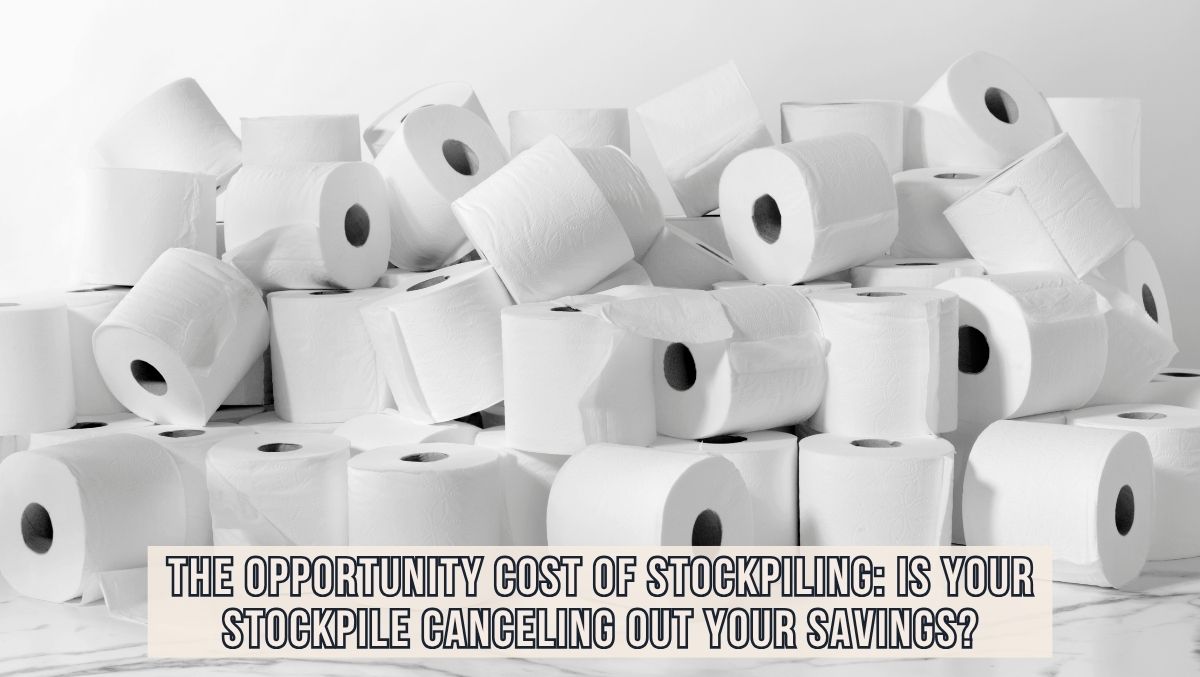
I am a fan of a useful stockpile.
Having extra food and household supplies on hand can help you buy things when prices are low rather than when you urgently need them. It can reduce extra trips to the store and provide a small cushion when the budget gets tight.
But stockpiling has another side that doesn’t get discussed as often.
Everything sitting in your stockpile represents money you’ve already spent.
- That $8 package of paper towels.
- The six jars of pasta sauce.
- Four bottles of shampoo.
- Twenty cans of soup.
- The extra meat in the freezer.
Individually, none may represent much money. Together, however, a well-stocked pantry, freezer and supply closet can easily hold hundreds of dollars’ worth of household inventory.
If you bought those things at prices below what you’d normally pay, you may have saved money.
But there’s still another question worth asking:
What else could that money have been doing for you?
That’s the opportunity cost of stockpiling.
And if your stockpile gets too large, some of the money you’re saving by stocking up may be offset by what those dollars aren’t doing elsewhere.
What Is the Opportunity Cost of a Stockpile?
Opportunity cost is simply the value of what you give up when you choose one use for your money over another.
Suppose you have $100 available.
You could use it to stock up on groceries and household supplies during a good sale.
Or that $100 could:
- Stay in your emergency fund
- Help pay this month’s bills
- Pay down a credit card balance
- Go toward your next car repair
- Earn interest in savings
- Cover an upcoming insurance premium
Once you turn the $100 into canned goods, laundry detergent and toilet paper, you still have something of value.
But you no longer have $100 readily available to pay the electric bill.
That’s the tradeoff.
It doesn’t make stockpiling a bad use of money.
It simply means you shouldn’t measure stockpile savings only by how much you saved at checkout.
A 40% Discount Isn’t Necessarily a 40% Financial Win
Suppose a product normally costs $5 and goes on sale for $3.
You use it regularly, so buying several makes sense.
Buy six instead of one and you’ve spent $18 for products that would normally cost $30. Eventually, assuming you use all six, you’ve avoided $12 in future spending.
Good stockpile purchase.
But what happens if you buy 24? Now you’ve spent $72. Yes, the regular retail value is $120. But you have also committed $72 of today’s money to one product.
If you’re carrying high-interest credit card debt, have an underfunded emergency account or are struggling to cover an upcoming bill, the extra inventory may not be the best place for all $72.
The first six may make excellent financial sense.
The next 18 might not.
The question isn’t simply whether the price is good. It’s how much you should buy at that price.
Credit Card Debt Can Change the Stockpiling Math
This is where opportunity cost becomes particularly important.
Suppose you’re carrying a credit card balance at a high interest rate.
You find $200 worth of stockpile bargains that you believe will save you $50 over the coming months.
That sounds worthwhile.
But what if putting that same $200 toward your credit card would reduce the amount of high-interest debt you’re carrying? Now you have two potential returns competing for the same dollars.
You don’t need to perform complicated calculations every time canned tomatoes go on sale.
But the principle matters: The higher the interest rate you’re paying on debt, the more valuable extra dollars can become when used to reduce that debt.
And there’s an even bigger warning sign: Don’t carry credit card debt because you spent too much building a stockpile.
Buying $100 worth of sale items and then carrying an extra $100 on a credit card balance can undermine the savings you were trying to create.
A bargain shouldn’t create debt.
Want MORE TIPS for Stretching Your Budget?
Get the free eBook with 226 simple money-saving tips — plus the Dollar Stretcher newsletter with practical, real-life ways to make a tight budget go further.
We value your privacy.
Unsubscribe anytime.
Your Stockpile Is Not Your Emergency Fund
A stocked pantry can absolutely help during a financial emergency. If income suddenly drops, having several weeks of food, toiletries and household necessities already purchased can reduce what you need to spend temporarily.
That’s valuable.
But a stockpile can’t replace cash savings.
- Your electric company doesn’t accept canned beans.
- A mechanic probably doesn’t want your extra laundry detergent.
- Your insurance company isn’t interested in the 12 pounds of chicken in your freezer.
You need some household supplies.
You also need liquidity — money you can use wherever the financial need occurs.
If you’re building a large stockpile while having almost no cash available for unexpected expenses, consider whether some of your stockpile dollars should remain dollars.
Savings Interest Matters, Too — But Keep It in Perspective
Money sitting in savings can earn interest. Money sitting on a pantry shelf doesn’t.
Technically, that creates another opportunity cost.
Suppose you spend $500 building a larger stockpile rather than keeping that $500 in an interest-bearing savings account.
You give up whatever interest that money could have earned while it was tied up in inventory.
However, don’t let this turn into unnecessarily complicated math.
If you’re saving 30% or 40% on products you’ll definitely use within a reasonable period, a few months of lost savings interest probably isn’t going to erase the benefit.
The comparison becomes more important when:
- Your stockpile is very large
- Inventory sits for a long time
- The discount was relatively small
- Your savings account pays a meaningful interest rate
- You could otherwise be paying down expensive debt
- You don’t have enough cash reserves for upcoming needs
The goal isn’t to calculate the lost interest on every jar of peanut butter.
It’s to recognize that cash has financial value beyond what it can buy at today’s sale.
About The Dollar Stretcher
The Dollar Stretcher shares practical ways to lower everyday costs, build steadier money habits and move from stuck to stable on a tight budget.
Learn more about how we can help you.
Get All 226 Money-Saving Tips—Free Download
You’ll also get our free newsletter each week. It’s full of useful ways to cut costs and stretch your dollars.
The Bigger Risk May Be Buying Too Far Ahead
A stockpile generally works best when you’re buying enough to get from one good buying opportunity to the next.
It becomes less efficient when you’re buying months or years into the future.
Why?
Because the farther ahead you buy, the more uncertainty you’re accepting.
- Your family may stop eating or using the product.
- Someone may develop different dietary needs.
- A favorite brand may change its formula.
- Storage conditions may damage products.
- Food quality may decline.
- A product may expire or spoil.
- You may discover a better alternative.
Or another equally good sale may appear long before you’ve used what you bought.
Every additional item you add to a stockpile has the potential to save money.
It also has the potential to become excess inventory.
Stockpile Turnover Matters More Than Stockpile Size
Rather than asking: How big should my stockpile be?
Try asking: How quickly does my stockpile turn over?
A family of six might reasonably use 12 jars of pasta sauce fairly quickly.
A household of two might take a very long time.
The number of products doesn’t determine whether you’ve overstocked. Usage does.
A useful stockpile moves. You buy products. You use them. You replenish them when prices are favorable.
If products mostly enter your stockpile but rarely leave it, you may be accumulating rather than stockpiling.
Find Your Personal Stock-Up Quantity
For frequently purchased products, it helps to know approximately how quickly you use them.
Suppose your household uses one jar of pasta sauce every two weeks.
- Six jars represent roughly three months of supply.
- Twelve jars represent roughly six months.
- Twenty-four jars represent close to a year.
Now the stock-up decision becomes easier.
You aren’t asking: How many can I afford while they’re $1.50?
You’re asking: How many will we realistically use before another reasonable buying opportunity comes along?
That’s a much better stockpile question.
A Sale Cycle Can Help Set Your Limit
You don’t necessarily need enough of a product to last forever.
You generally need enough to get you to another good price.
Sales vary by product and retailer, so there isn’t one universal stock-up period. But once you pay attention to the products your household regularly buys, you may notice that good prices come around more often than you thought.
That can take some urgency out of stockpiling.
If pasta regularly reaches a price you’re happy with, you don’t need 40 boxes every time it happens. Buy enough to carry you comfortably until you’re likely to find another acceptable price.
The goal is to bridge the gap between good buying opportunities, not eliminate the need to shop for the next three years.
The Best Stockpile Items Usually Have Four Things in Common
The strongest stockpile purchases tend to meet four conditions:
- You regularly use the product. Don’t stockpile something because you might start using it.
- The price is genuinely good. A large package, warehouse-store purchase or “stock-up event” isn’t automatically a bargain. Know your usual price.
- You can use it before quality or safety becomes an issue. Consider expiration, best-quality dates, freezer life and how quickly your household consumes it.
- Buying it doesn’t interfere with a more important use for the money. This is the opportunity-cost test. A good price can wait if buying it means you won’t have enough money for something that matters more.
4 Rules for Keeping Your Stockpile a Money-Saver
A stockpile should help you spend less, not tie up more money than necessary. These four simple rules can help you keep your stockpile at a useful level while avoiding some of the costs that can quietly offset your savings.
1. Set a Stockpile Budget, Not Just a Stockpile Goal
If you enjoy stocking up, consider giving stockpiling its own budget.
Instead of thinking: I’ll stock up whenever I see a great deal,
decide: I have $25 this week for stock-up purchases. Or $40. Or whatever comfortably fits your budget.
This puts a natural limit on how much money gets converted into household inventory.
It also forces you to prioritize.
If chicken, coffee, detergent and canned vegetables are all on sale, which purchases offer the best combination of savings and likely use?
You don’t have to capture every deal.
You want the deals that do the most for your budget.
2. Replenish What You Use Instead of Constantly Expanding
One of the easiest ways to overstock is to treat every sale as an opportunity to add more.
Try thinking of your stockpile as something you replenish, not something you continually grow.
You use two bottles of shampoo. Eventually, a good price comes along and you replace them.
You use several freezer meals. You restock the ingredients when prices make sense.
That creates a working household inventory rather than an ever-expanding collection of bargains.
Once you reach a comfortable stockpile level, your goal changes from building to maintaining.
That distinction can protect a lot of cash.
3. Don’t Ignore the Cost of Storage
The products aren’t always the only stockpiling expense.
If your stockpile grows large enough, you may start buying:
- Extra shelving
- Storage bins
- Additional pantry organizers
- Vacuum-sealing supplies
- A second refrigerator or freezer
- Electricity to run extra cold storage
Some of those costs can make sense.
A freezer that lets a family take advantage of meat sales, preserve garden produce and reduce food waste may easily earn its keep.
But storage isn’t free simply because you already own the products inside it.
Include storage costs when evaluating a large stockpile.
4. Watch for “Stockpile Creep”
A stockpile often starts sensibly.
Two extra jars become six. Six cans become 20. One shelf becomes a closet.
The problem isn’t any single purchase. It’s accumulation.
Every deal seems reasonable on its own, so you never stop to calculate how much money is sitting there altogether.
Once or twice a year, estimate the value of your stockpile.
You don’t need an exact inventory.
Walk through the pantry, freezer and household supplies and roughly estimate what you paid.
Is it $100? $300? $800? $1,500?
Then ask: If I had that amount in cash today, how much of it would I choose to spend rebuilding this exact stockpile?
That question can be revealing.
How To Find Your Stockpile Sweet Spot
No single ideal number of weeks or months of supplies fits every household.
Your balance depends on:
- Available cash
- Debt
- Storage space
- Household size
- Consumption rate
- How often good prices appear
- Distance from stores
- Income stability
- Dietary or product preferences
- Risk of spoilage or waste
But you can use a simple hierarchy:
- Protect the current month’s essentials. Don’t stock up so aggressively that you’re short on rent, utilities, insurance, transportation, medication or other necessary expenses.
- Maintain some accessible savings. A stockpile can support an emergency fund, but it shouldn’t replace one.
- Consider expensive debt. If you’re carrying high-interest debt, be selective about how much cash you tie up in extra inventory.
- Build enough inventory to take advantage of meaningful savings. Stock up on products you regularly use when the discount is worthwhile and the purchase fits comfortably within your available cash.
- Stop when additional inventory produces diminishing benefits. Once you have enough to reach the next likely sale, the 13th bottle may provide much less financial benefit than the third bottle did. At some point, keeping the cash becomes more valuable than adding another bargain.
Budget Level Savings: How Much Should You Stockpile?
No need to tackle every tip at once. Start with the tips best suited for your budget.
If money is stretched and savings need to be meaningful:
Keep your stockpile lean and useful.
Focus on products you use regularly and deals that deliver real savings. Don’t tie up money you need for this month’s bills.
A small cushion of food and household necessities can be extremely helpful when money is tight, but accessible cash matters, too.
Prioritize high-use, high-savings items, not stockpile size.
If you’re cutting back but still have some flexibility:
Then you have more flexibility to buy ahead when prices are favorable.
Consider keeping enough of frequently used products to bridge the gap between good buying opportunities.
At the same time, continue funding savings and other financial goals rather than automatically putting every extra grocery dollar into more inventory.
Once your stockpile reaches a useful level, switch from building it to maintaining it.
If you just want small, easy wins:
A larger stockpile may be convenient, but having room in the budget doesn’t automatically make more inventory financially efficient.
Consider whether excess cash could be earning interest, invested toward longer-term goals or simply kept available for future needs.
Buy ahead when the savings and convenience justify it, not because you have enough money and storage space to do so.
TDS Takeaway: The Goal Isn’t the Biggest Stockpile. It’s the Most Useful One.
A good stockpile should make your financial life easier.
- It lets you buy at favorable prices.
- It gives you supplies to draw from when money gets tight.
- It can reduce emergency store trips.
- It can protect you from temporary price spikes.
But every dollar sitting on a shelf is a dollar you’ve already committed.
If you have $700 worth of extra groceries and household supplies while carrying high-interest debt, struggling to pay bills or having almost nothing in emergency savings, part of your “savings” may be sitting in the wrong place.
That doesn’t mean emptying the pantry.
It means finding your balance.
- Stock enough to benefit from lower prices.
- Use what you stock.
- Replenish rather than endlessly expand.
- And occasionally ask whether the next $20 would save you more on the shelf or somewhere else in your financial life.
That’s the opportunity cost of stockpiling.
And understanding it can help make sure your stockpile is actually stretching your dollars instead of simply storing them.
Should I Stock Up More or Keep the Cash?
Before adding another stock-up purchase, ask:
- Will we definitely use it? If you’re unsure, keep the cash.
- Is this price meaningfully lower than what I normally pay? A tiny discount may not justify buying months ahead.
- How much do I already have? Count before you buy.
- When will we realistically use this purchase? Buying six weeks ahead is different from buying two years ahead.
- Will another good buying opportunity probably come before we run out? If yes, you may already have enough.
- Do I have enough money for upcoming bills and expenses? Those come before building inventory.
- Do I have accessible emergency savings? Household supplies can help in an emergency, but they can’t pay most emergency expenses.
- Am I carrying expensive debt? Compare the additional stockpile savings with the value of putting extra cash toward that balance.
- Am I buying to replenish or simply adding more? A mature stockpile should have products regularly going out as well as coming in.
Then ask the opportunity-cost question:
If I didn’t spend this $20 stocking up today, what would that $20 do instead?
If the answer is “sit in checking until I eventually spend it on these same products at a higher price,” stocking up may be the better use.
If the answer is “keep me from carrying another $20 on a high-interest credit card,” keeping the cash may win.
Did this article help you save or stretch a few dollars or plug a financial leak? The Dollar Stretcher can help you make your dollars go even further.
Join the free Dollar Stretcher newsletter to get money-saving tips and articles delivered to your inbox each week, plus a copy of the 226 money-saving tips eBook — a reference you can use whenever money feels tight.
About the Author
Andrea Norris-McKnight is the Money-Saving Strategist behind The Dollar Stretcher.
She helps people on tight budgets cut everyday costs, build steadier money habits and create a little breathing room—without guilt, gimmicks, or unrealistic advice.
More Ways To Save
Why a Small Household Stockpile Can Save You Money and Stress
You don’t need a large inventory of household supplies, food or toiletries to see the benefits of stockpiling.

Is a Warehouse Club Membership Worth It on a Tight Budget?
This quick guide explains when a warehouse club membership saves money and when it doesn’t

When a “Good Deal” Isn’t Good for Your Budget
When the Cheapest Home Supplies Can End Up Costing the Most
About The Dollar Stretcher
The Dollar Stretcher shares practical ways to lower everyday costs, build steadier money habits and move from stuck to stable on a tight budget.
Learn more about how we can help you.